

 Request Information on WhatsApp
Sorry for the inconvenience.
Search again what you are looking for





Professional progressive cavity pumps, also known as eccentric screw pumps, single-screw pumps or helical rotor pumps, are designed for the controlled transfer of liquid, viscous and semi-dense products in pharmaceutical, galenic, cosmetic, biotechnology, nutraceutical, food and industrial applications. Their operating principle provides a regular and controllable flow that is directly related to rotor speed, making this technology particularly useful when the product must be transferred continuously and with consistent process control.
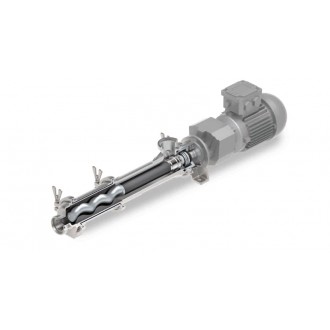
Inside the stator, a helical rotor rotates and creates a sequence of progressive cavities that move the product from the suction side towards the discharge. The volume of these cavities, together with the rotational speed, determines the volumetric flow rate of the pump. By using a frequency inverter or a motor with integrated inverter, the speed can be adjusted to adapt the transfer rate to the actual requirements of the process.
Progressive cavity pumps can be integrated into systems for pharmaceutical, cosmetic and R&D production, creating complete solutions for transfer, feeding, dosing and handling of different formulations.
The operating principle is based on the interaction between a helical rotor and a specially shaped stator. As the rotor turns, a series of sealed cavities is formed and moves progressively along the pump axis, carrying the product from the suction side to the discharge side.
Unlike pumps that primarily accelerate the liquid with an impeller, a progressive cavity pump moves the product through defined internal volumes. This makes the flow comparatively regular and predictable and can be particularly useful when handling viscous or semi-dense formulations.
The flow rate is directly related to rotor speed. Within the permitted operating range, increasing the speed increases the amount of product transferred per unit of time, while reducing the speed decreases the flow.
One of the main characteristics of progressive cavity technology is the relationship between rotational speed and volumetric flow. Under comparable operating conditions, increasing rotor speed increases flow rate, while reducing speed decreases the transferred volume.
This characteristic allows the same pump to work at different production rates within its operating range. It can therefore adapt to different phases of a process without necessarily changing the pump itself.
The optimum operating speed should be selected according to viscosity, temperature, product rheology, discharge pressure, pipeline diameter and the expected duration of the production cycle.
The use of a frequency inverter or a motor with integrated variable-speed control makes it possible to adjust rotor speed progressively and therefore regulate the flow rate without mechanical changes to the pump.
This is particularly useful in laboratories and production plants that handle different batch sizes or products with different viscosities. A higher flow may be required during bulk transfer, while reduced speed may be preferable during feeding, dosing or filling operations.
Electronic speed control also facilitates gradual start-up and integration into semi-automatic and automated process lines.
In pharmaceutical applications, progressive cavity pumps can be used for compatible solutions, liquid bases, semi-dense preparations and other products where a controlled and continuous transfer is required.
The selection should consider all product-contact materials, including the stator, rotor, seals, fittings and other wetted components. Cleaning procedures and real operating conditions are also essential selection parameters.
For specific pharmaceutical processes, construction details, surface finishing, documentation and internal qualification requirements may also need to be considered.
In galenic production, progressive cavity pumps can assist with the transfer of creams, gels, bases, suspensions, solutions and semi-liquid preparations, particularly in small and medium production batches where controlled transfer speed is important.
The ability to reduce rotor speed through an inverter is useful when the formulation must be moved slowly from a preparation vessel to a dosing or packaging machine.
The pump can be integrated with preparation vessels, mixers, piping systems, dosing equipment and other components commonly used in galenic laboratories.
In cosmetic production, eccentric screw pumps can be used for creams, gels, detergents, shampoos, conditioners, emulsions, lotions, cosmetic bases and other formulations with different viscosity levels.
These products often require more controlled handling than low-viscosity liquids. Progressive cavity geometry can maintain a regular transfer even when viscosity increases, provided that the pump is correctly sized.
The pump may transfer product from a mixer to a storage tank, from a tank to a filling machine or between different stages of the production line.
One of the main applications of progressive cavity pumps is the handling of high-viscosity products. Creams, gels, fluid pastes and dense formulations can be difficult to move efficiently with pump technologies primarily intended for very low-viscosity liquids.
The progressive cavity principle creates defined transfer volumes that move along the stator, allowing many viscous products to be handled with a regular and controllable flow.
Actual performance depends on viscosity, temperature, discharge pressure, pipe diameter and formulation characteristics. Very dense products may require careful evaluation of suction conditions, pump speed and line layout.
Many pharmaceutical and cosmetic formulations have structures that can be sensitive to excessive mechanical stress. A progressive cavity pump can be a suitable option when a smooth and continuous transfer is preferred.
Rotor speed plays an important role. Operating at an appropriate speed helps adapt the transfer to the rheological behaviour of the formulation and avoids unnecessary operating conditions.
For particularly sensitive emulsions, the real behaviour of the product should always be assessed as part of the technical selection.
Progressive cavity pumps can be installed downstream of tanks, preparation vessels, reactors and mixers to transfer the finished or intermediate product towards the next production stage.
In research and development environments, they can be combined with professional laboratory sample preparation equipment to support formulation development, pilot testing and scale-up activities.
When moving from laboratory scale to production scale, it is important to reassess viscosity, required flow, pipe diameter, transfer distance and operating time rather than simply increasing motor power.
Progressive cavity pumps are part of a wider range of technologies used for liquid handling and should be selected by comparing them with other industrial pumping, transfer and dosing systems.
The most appropriate pump technology depends on the product and process. Low-viscosity liquids may be handled more efficiently with other pump designs, while progressive cavity pumps can offer significant advantages for higher viscosities and applications requiring controllable volumetric transfer.
Selection should therefore begin with real process data rather than only motor power or nominal connection size.
A progressive cavity pump can be used to feed downstream dosing and filling equipment while maintaining a product supply compatible with the requirements of the machine.
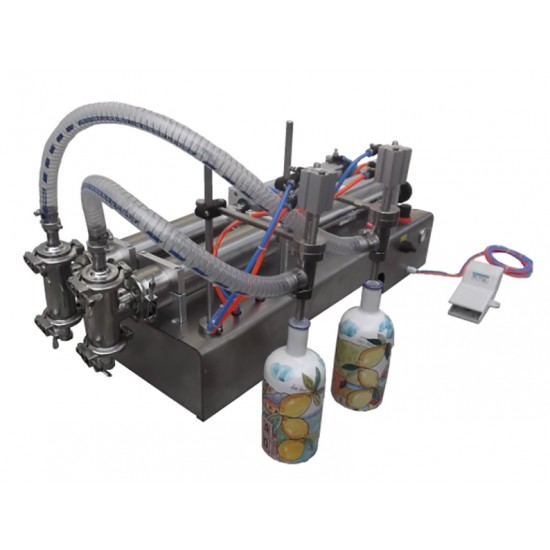
Integration with professional volumetric filling machines makes it possible to create complete process lines in which the pump transfers the formulation from a preparation or storage tank to the filling stage.
Pump and filler should be coordinated to prevent insufficient product supply, excessive pressure or undesirable flow variations at the filling machine.
Pump sizing depends on the required flow rate, viscosity, discharge pressure, temperature, density, raw-material characteristics and suction conditions.
In general, larger pump sizes may achieve a required flow at a lower rotational speed, while smaller units may need to operate at a higher speed. However, this relationship should always be evaluated according to the specific product and operating conditions.
The smallest pump capable of reaching a target flow is not automatically the best choice, because the required rotational speed may not be ideal for the product or for the expected duty cycle.
Viscosity is one of the main parameters in the selection of a progressive cavity pump. As viscosity increases, resistance through pipes, bends, fittings, filters and process equipment can increase significantly.
Viscosity should always be considered at the actual process temperature. A cream or gel may be relatively fluid during hot preparation but become considerably denser once it cools before transfer.
Sizing calculations should therefore use values that reflect real operating conditions rather than generic product descriptions.
The pump must be able to overcome the total resistance of the system without operating outside its intended range. Long pipelines, small diameters, multiple fittings, valves and filters can substantially increase the required discharge pressure.
With viscous products, even relatively small changes in pipe diameter may have a strong effect on pressure losses.
For this reason, the full product path should be evaluated rather than considering only the distance between the source and destination vessels.
Suction conditions are especially important when progressive cavity pumps handle very dense products. The product must be able to reach and fill the pump cavities adequately.
Tank position, suction height, suction-pipe diameter and product temperature can all have a significant effect on pump performance.
For very viscous formulations, the pump may need to be positioned close to or below the vessel outlet or be combined with a specific feeding configuration.
The stator is one of the key components of a progressive cavity pump and should be selected according to product chemistry, temperature and process conditions.
A stator material that performs well with the production product may not necessarily be compatible with a detergent used during cleaning. Compatibility should therefore cover both the production and washing cycles.
For pharmaceutical, cosmetic and chemical applications, detailed information about raw materials and cleaning agents is particularly important before defining the final pump configuration.
In addition to the stator, the pump body, rotor, seals, mechanical sealing system, fittings and all other product-contact parts should be evaluated.
Material selection should be based on the chemical characteristics of the formulation and the specific requirements of the production sector.
Correct compatibility supports longer component life and helps reduce the risk of premature deterioration or unwanted interaction with the product.
An inverter allows the motor speed to be changed without replacing mechanical components. This makes it possible to use the pump with different products, flow rates and production phases.
Lower speed can be selected when a slower transfer is required or when the formulation benefits from gentler handling, while higher speed can increase flow within the permitted operating range.
Variable-speed control can also facilitate smooth start-up and integration with automated process control systems.
In R&D laboratories, progressive cavity pumps can be used to study the transfer behaviour of viscous formulations and to reproduce on a smaller scale operations that will later be transferred to industrial production.
Adjustable speed allows different flow conditions to be evaluated and can help generate useful information for scale-up.
Further equipment for laboratory and production processes can be found in the PDF catalogues for laboratory equipment.
The correct selection begins with the product and the actual operating conditions. Important data include viscosity, density, minimum and maximum temperature, chemical composition, possible particles and the sensitivity of the formulation to mechanical stress.
The required flow rate, discharge pressure, suction conditions, pipeline diameter, line length and operating method should then be defined.
It is also useful to specify whether variable-speed control is required, whether operation will be continuous or intermittent and whether the pump will feed dosing, filling or other downstream equipment.
The pump should be included in the cleaning procedures established for the complete production line. Viscous products can leave residues inside the stator, fittings and internal passageways, so these areas should be cleaned according to the procedures defined by the user.
The rotor, stator, seals and other wear components should be inspected periodically. Maintenance intervals depend on the product, rotational speed, pressure, operating hours and cleaning methods.
Correct initial selection and operation within the intended conditions help maintain consistent performance over time.
Ariacqua supplies progressive cavity pumps and transfer systems for pharmaceutical, galenic, cosmetic, biotechnology, nutraceutical, food and industrial laboratories and production plants. Each configuration is evaluated according to the product, viscosity, required flow rate, pressure and process-control requirements.
The possibility of integrating pumping, mixing, preparation, dosing and packaging equipment makes it possible to develop coordinated solutions that move formulations from preparation through to subsequent stages of production.
The terms progressive cavity pump, eccentric screw pump and single-screw pump are commonly used for the same general pump technology. The operating principle uses a helical rotor that turns eccentrically inside a specially shaped stator, creating cavities that progress from suction to discharge. The term “progressive cavity” describes the physical movement of these internal cavities, while “eccentric screw” and “single-screw” refer more directly to the rotor geometry. For technical selection, the terminology itself is less important than the process data. Viscosity, flow rate, pressure, temperature, stator material and rotational speed determine how a specific pump will behave. Two pumps belonging to the same technological family can therefore have very different operating ranges depending on their size, geometry and configuration.
The progressive cavity principle moves the product through defined internal volumes that travel along the stator. This behaviour is particularly useful for fluids that do not flow easily and may be difficult to transfer with technologies mainly intended for low-viscosity liquids. Creams, gels, emulsions, cosmetic bases and semi-dense formulations can therefore be transferred with a regular flow when the pump is correctly sized. Viscosity is not the only parameter, however. Temperature, pressure, pipe size, suction conditions and product chemistry all influence performance. A very viscous formulation may require reduced rotor speed, a larger suction pipe or a different pump position. Technical selection should therefore be based on the actual process conditions rather than only on the generic product name.
Yes. One of the key advantages of progressive cavity pumps is the relationship between rotational speed and flow rate. Within the operating range of the pump, reducing rotor speed reduces the quantity transferred per unit of time, while increasing speed increases the flow. A variable-frequency drive can therefore be used to adjust the pump to different products and production phases. This is especially useful in pharmaceutical, galenic and cosmetic applications where the same line may handle different batches or where different stages require different flow rates. Speed control should nevertheless always remain compatible with viscosity, suction conditions, pressure and the limits of the selected pump. Excessive speed with a very viscous product can create poor filling conditions at the suction side, while excessively low speed may not provide the required production capacity.
Yes. A progressive cavity pump can be used as a feed pump for volumetric fillers and other downstream dosing equipment when the product and process conditions are suitable. The pump transfers the formulation from the preparation or storage vessel to the filling machine and can maintain a controlled supply flow. Inverter control can help match the flow to the production rate of the filling equipment. The complete system should be designed as a coordinated process. Insufficient feed can cause the filler to run short of product, while excessive pressure can affect valves, seals or other components. Product viscosity, transfer distance, pipe diameter, elevation difference, required pressure and the behaviour of the filling machine should therefore all be considered when sizing the pump.
Material selection depends on the actual formulation and on the cleaning procedures used in the production line. The pump body, rotor, stator, seals, fittings and every product-contact component should be assessed. In pharmaceutical and galenic production, cleanability, surface quality and internal qualification procedures may also be important. In cosmetic production, oils, surfactants, solvents, fragrances, bases and other ingredients can interact differently with elastomers and sealing materials. Cleaning and sanitising agents should also be included in compatibility checks because a component that performs well with the process formulation may not be suitable for the cleaning chemical. Technical or safety data sheets, operating temperature and information about cleaning media are therefore useful for defining the correct pump configuration.
Viscosity affects both the ability of the product to reach the pump at the suction side and the pressure losses generated throughout the transfer line. A highly viscous product offers greater resistance to movement and may require larger pipes, more favourable suction conditions and lower rotational speed. Viscosity should always be considered at the actual operating temperature. A cream that is relatively fluid immediately after hot preparation may become much denser once cooled before transfer. If the pump is selected using a viscosity value that does not represent the real process, the actual flow rate can differ substantially from expectations. Pipe length, bends, valves, filters and other components should also be considered when calculating the total resistance of the line.
No. A larger pump is not automatically the best option. Pump size should be selected to provide the required flow rate at a rotational speed that is appropriate for the product and expected duty cycle. A larger pump may deliver a given flow at a lower speed than a smaller pump, but oversizing can increase cost, footprint and complexity without providing a meaningful process advantage. Conversely, a pump that is too small may need to run at high speed to reach the required flow, which may not be ideal for dense formulations. The optimum selection therefore balances flow rate, speed, viscosity, pressure and operating hours. The intended inverter control range should also be included in the evaluation.
Reliable selection requires detailed information about both the product and the complete transfer circuit. Important data include product type and composition, viscosity at working temperature, density where relevant, minimum and maximum temperature, possible particles, required flow rate and discharge pressure. Suction height and conditions, pipe diameter and length, bends, fittings and equipment installed in the line should also be specified. It is also useful to define operating hours, continuous or intermittent use, the need for inverter control and the equipment that the pump will feed downstream. In pharmaceutical, galenic and cosmetic applications, cleaning procedures and cleaning chemicals should also be included. With these data, pump size, rotational speed, materials and configuration can be selected much more accurately for the real process.
We supply high-quality professional equipment and customized solutions designed to meet the specific needs of every customer. Our experienced team provides expert support in selecting the most suitable products, offering reliable solutions, technical assistance and tailor-made configurations for companies, laboratories, industrial applications and professional environments.
Contact us for product information, personalized advice and professional support in choosing the ideal equipment for your business requirements.
Search again what you are looking for