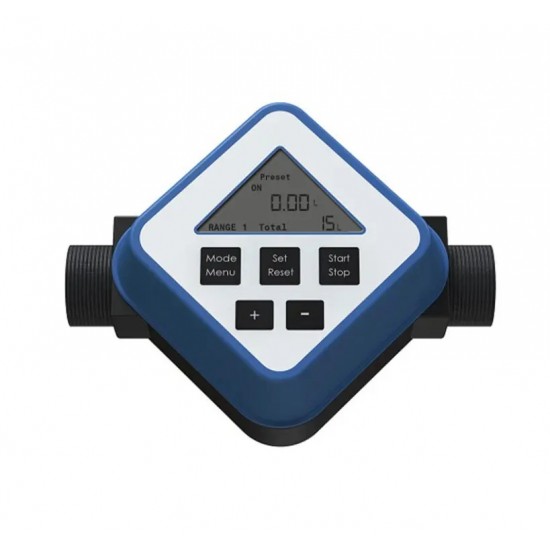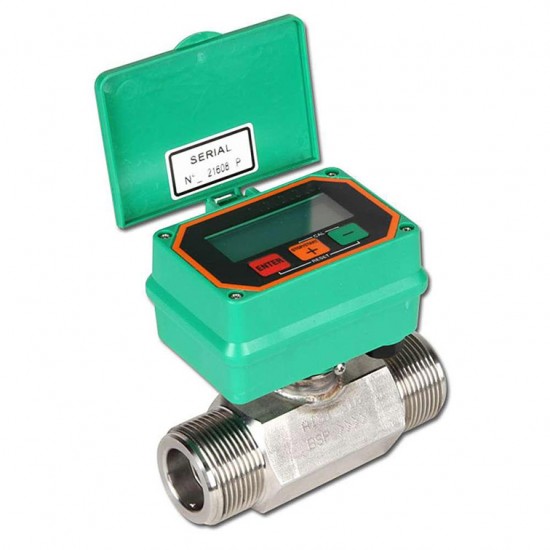

Digital flowmeter for chemical and corrosive liquids. 20-120 litres/minute
Digital and Mechanical Litre Counters for Industrial Liquids
Professional digital and mechanical litre counters are designed to measure, monitor and manage the volume of liquids transferred in pharmaceutical, chemical, cosmetic, biotechnology, nutraceutical, food and industrial laboratories and production plants. Installed directly in the transfer line, they allow operators to monitor the quantity of product moved during transfer, feeding, dispensing and filling operations.
Ariacqua offers configurations with materials selected according to the specific product being handled, its viscosity, temperature, chemical compatibility and actual operating conditions. Mechanical and digital versions are available, together with models featuring a display mounted directly on the instrument or a remote cable-connected display, useful when the reading point needs to be positioned away from the product line.
For applications requiring more advanced control, configurations can include a preset quantity function and an integrated shut-off valve. The litre counter can be incorporated into professional pumping, transfer and dosing systems, creating a complete solution for controlled liquid handling.
What is a professional litre counter used for?
A litre counter measures the quantity of liquid passing through a pipeline during transfer. Unlike a simple visual flow indicator, it provides quantitative information that can be used to determine how many litres have been transferred from one vessel to another, monitor raw-material consumption, prepare a production batch or control manual and semi-automatic dispensing operations.
Depending on the model, the instrument can display the quantity transferred during the current operation and also maintain a cumulative total. This makes it easier to monitor internal product movements and allows operators to verify the actual quantity transferred during each working cycle.
The correct model should be selected according to the liquid and the actual line conditions. Minimum and maximum flow rate, viscosity, temperature, pressure and chemical characteristics can all influence the accuracy and correct operation of the measuring system.
Digital litre counters for pharmaceutical and chemical laboratories
Digital litre counters provide an immediate electronic reading of the transferred volume and are particularly suitable for laboratories and production plants where quantities need to be checked frequently during transfer, batch preparation or equipment feeding.
A digital display simplifies reading when operators handle different quantities throughout the working day. Depending on the selected model, additional functions may include batch reset, cumulative totalisation, preset quantities and remote display capability.
The selection of a digital litre counter should not be based only on the required measuring range. The actual behaviour of the raw material must also be considered. Viscous, aggressive, sensitive or particle-containing products may require a specific measuring principle and specific product-contact materials.
Professional mechanical litre counters
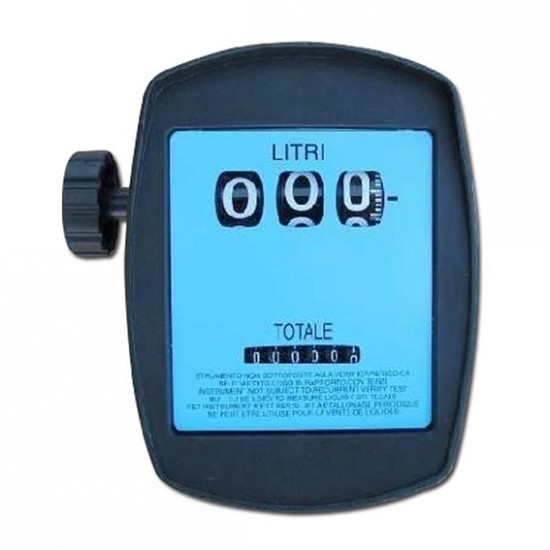
Mechanical litre counters provide a robust and straightforward solution for measuring transferred volume without necessarily relying on an electronic display or external electrical supply. They can be used in many industrial applications when their measuring principle and materials are compatible with the product.
The transferred volume is displayed through a mechanical counting system. This configuration can be useful when a simple, easily readable and dedicated measuring instrument is required directly on a transfer line.
As with digital models, the selection must take into account the operating flow range, viscosity, pressure, temperature and chemical compatibility of every component in contact with the liquid.
Litre counters with remote display
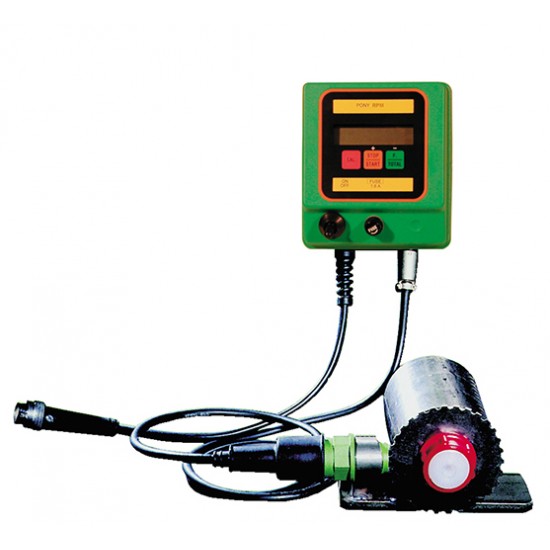
When the measuring point is difficult to access or the volume must be read from a separate operator station, a litre counter with a cable-connected remote display can be used.
The measuring body remains installed directly in the pipeline, while the display can be positioned in a more convenient location for the operator. This configuration is useful on process skids, lines installed at floor or overhead level, equipment located behind guards or installations where direct access to the measuring body is limited.
The available cable length, power supply and installation arrangement should be selected according to the specific model and layout of the plant.
Preset quantity control
For repeated transfer operations, certain litre counters can be equipped with a preset quantity function. The operator sets the volume required for the operation and the system monitors the quantity delivered during the transfer cycle.
This function is useful when predefined quantities must be transferred regularly, for example when preparing batches, feeding vessels or distributing specific quantities of liquid raw material.
A preset function turns the instrument from a simple volume reader into a more structured control component within the process. The actual performance depends on the measuring technology, product properties and correct configuration of the complete line.
Litre counters with integrated shut-off valve
Certain configurations can incorporate a shut-off valve that stops the transfer when the preset volume has been reached. This makes it possible to partially automate product distribution and reduce the need for continuous operator supervision.
The solution can be especially useful in repetitive transfer and filling operations where the same quantity must be dispensed several times during production.
The valve, measuring instrument and pump must be sized as a single system, taking into account flow rate, pressure, viscosity and the behaviour of the product when the line is closed.
Applications in pharmaceutical production
In pharmaceutical laboratories, litre counters can be used to monitor the transfer of solutions, liquid excipients, process detergents, intermediates and other compatible raw materials. Volume measurement can support batch preparation and the monitoring of internal liquid movements.
Selection should consider product-contact materials, cleaning procedures and actual operating conditions. For specific applications, instrument documentation, verification or calibration requirements may also need to be considered.
A litre counter does not automatically replace a validated dosing system or process weighing solution, but it can be an important component for monitoring and controlling the quantity of liquid transferred.
Applications in chemical laboratories
In chemical processing, litre counters may be used to measure the transfer of solutions, detergents, additives, reagents and other liquid raw materials. Chemical compatibility is particularly important because all wetted parts must withstand the product under actual operating conditions.
Concentration, working temperature and the possible presence of aggressive components can influence the selection of the meter body, seals and measuring technology.
For chemical applications, it is therefore advisable to provide detailed product information and real operating conditions before selecting the final configuration.
Litre counters for cosmetic and nutraceutical production
In cosmetic and nutraceutical manufacturing, litre counters can be used to monitor the transfer of oils, solutions, extracts, detergents, liquid bases, lotions and other compatible formulations.
Volume measurement may be useful when feeding mixers, transferring product between tanks or distributing liquids towards subsequent production stages.
For more viscous formulations, an appropriate measuring technology should be selected and the pressure drop created by the instrument should be checked carefully, especially in systems working at relatively low flow rates.
Applications in food production
In food-processing applications, litre counters can be used with water, oils, sugar solutions, beverages, liquid ingredients and other products compatible with the selected construction materials.
When the instrument comes into direct contact with food products, the suitability of wetted materials, seals and connections should be verified. Cleaning and sanitation procedures must also be taken into account.
Correct sizing helps provide reliable measurement without creating unnecessary restrictions in the transfer line.
Integration with liquid dispensing guns
One particularly practical application is the installation of a litre counter in a line fitted with professional liquid dispensing guns.
The pump moves the product through the system, the litre counter records the transferred volume and the operator uses the dispensing gun to control the final delivery point. If the meter includes a preset function and the system is fitted with an automatic shut-off valve, the transfer can also be stopped when the programmed volume has been reached.
This configuration can be used to fill containers, cans, process vessels and tanks with controlled quantities of liquid.
Litre counters with industrial electric pumps
Litre counters can be integrated with industrial electric pumps to create systems for the regular transfer of liquids between drums, tanks, containers and process machines.
The pump should provide a flow rate within the operating range of the selected meter. A flow that is too low or too high compared with the instrument specification may affect measurement quality and overall system performance.
The pressure drop created by the meter should also be taken into consideration when sizing the pump and the complete transfer line.
Litre counters with progressive cavity pumps
For viscous products, creams, gels and fluids requiring a smooth and controlled transfer, the litre counter can be evaluated together with professional progressive cavity pumps.
Compatibility between the meter and the product must be checked carefully, because not every measuring technology is suitable for high-viscosity fluids. Flow rate, viscosity, temperature and the possible presence of particles should all be considered.
The complete system should be sized to maintain product velocity and pressure conditions compatible with both the pump and the measuring instrument.
Litre counters with pneumatic pumps
Litre counters can also be installed in systems supplied by professional pneumatic pumps for liquid and viscous product transfer.
In these applications, possible flow pulsation should be considered and the selected measuring principle should be suitable for the actual behaviour of the pump. Air regulation, pressure and operating flow should be configured consistently with the requirements of the litre counter.
Correct integration makes it possible to create flexible systems for transferring, measuring and distributing different liquid raw materials.
Minimum and maximum flow rate
Every litre counter has an operating flow range within which it can measure correctly. For this reason, pipeline diameter alone is not sufficient for selecting the instrument.
The actual minimum and maximum flow rates expected during production should be known. An oversized meter may operate poorly at very low flow rates, while an undersized model may create excessive pressure loss or be used beyond its intended limits.
Correct selection therefore starts from the real process data rather than only from the nominal pipe size.
Viscosity and measurement accuracy
Viscosity is one of the parameters that can have the greatest influence on the behaviour of a litre counter. Certain technologies are particularly suitable for low-viscosity liquids, while others can operate more effectively with oils and denser fluids.
Viscosity should be evaluated at the actual operating temperature, because the same product can behave very differently during production and at ambient temperature.
To obtain consistent measurement, the measuring technology should therefore be selected according to the real physical behaviour of the liquid.
Materials and chemical compatibility
The meter body, internal measuring components, seals and connections must be compatible with the raw material. Cleaning and sanitising products should also be included in the material compatibility assessment.
A configuration can be suitable for the production liquid but incompatible with a detergent used periodically on the line. Chemical resistance should therefore cover the entire working and cleaning cycle.
For correct selection, it is advisable to provide the product technical data sheet, concentration, operating temperature and cleaning procedure.
Main advantages of professional litre counters
- Measurement of transferred liquid volume.
- Digital and mechanical versions available.
- Partial and cumulative volume monitoring.
- Remote cable-connected display options.
- Preset quantity configurations.
- Possible integrated shut-off valve.
- Materials selected according to the processed liquid.
- Integration with pumps and dispensing systems.
- Suitable for laboratories and production plants.
- Applications in pharmaceutical, chemical, cosmetic and food processing.
How to choose the correct litre counter
The first step is to identify the liquid that must be measured. Important parameters include chemical composition, viscosity, temperature, density where relevant, possible particles and chemical aggressiveness.
The minimum and maximum flow rate, operating pressure, pipe diameter, connection type, typical transferred volume and required accuracy should then be defined.
It is also important to specify whether a local or remote display is required, whether a preset quantity function is needed and whether the system should stop automatically once the programmed volume has been reached.
Cleaning, checking and maintenance
The litre counter should be included in the cleaning procedures for the complete transfer system. Deposits inside the measuring body can affect operation and, depending on the technology used, may also affect measurement accuracy.
Seals, connections, displays and internal components should be inspected periodically according to the instrument configuration and application. Where a defined level of measurement accuracy is required, periodic checking or calibration procedures may be appropriate.
The frequency of inspection depends on the product, operating hours, working conditions and quality requirements of the process.
Why choose Ariacqua?
Ariacqua supplies digital and mechanical litre counters for measuring and monitoring liquid raw materials in pharmaceutical, chemical, cosmetic, biotechnology, food and industrial laboratories and production plants. Each configuration is evaluated according to the product, flow rate, pressure, viscosity and required level of process control.
The possibility of integrating litre counters with pumps, dispensing guns, valves and preset quantity systems makes it possible to create complete solutions for controlled liquid transfer, measurement and distribution.
Frequently asked questions about digital and mechanical litre counters
What is the difference between a digital and a mechanical litre counter?
The main difference concerns the display system and, in some cases, the functions available. A mechanical litre counter uses a mechanical indication system to show the volume that has passed through the instrument and is generally selected when a simple solution is required for monitoring transferred quantities. A digital litre counter uses an electronic display, which can make reading easier and may also support additional functions such as batch reset, totalisation, remote display or preset quantities. The choice should not be based only on the display type. The measuring technology, flow range, compatible viscosity, pressure, temperature and wetted materials are often more important. For some applications, a basic mechanical solution is sufficient, while in others the additional control offered by a digital system can provide significant operational advantages.
Can a litre counter be used for accurate dosing?
A litre counter measures the volume passing through the line, but turning this measurement into a controlled dispensing operation depends on the overall system configuration. With a preset function, the operator can enter the required quantity and monitor the transfer as the target volume is approached. If the system also includes an appropriately controlled shut-off valve, the flow can be stopped automatically once the programmed volume has been reached. Actual accuracy depends on the measuring technology, valve behaviour, stability of the flow, product viscosity and the hydraulic characteristics of the line. In applications where dosing is critical or subject to very tight tolerances, the required accuracy should be clearly defined so that it can be determined whether a litre counter is sufficient or whether a more specialised dosing system is required.
What are the advantages of a remote display?
A remote display allows the volume data to be viewed at a location separate from the measuring body. This is particularly useful when the meter is installed beneath machinery, behind a safety guard, on an inaccessible pipe run or at a height that makes direct reading difficult. With a cable-connected display, the reading can be positioned on a panel, frame or operator station where it is easier to see. This means operators can monitor the transferred quantity without repeatedly approaching the measuring point. The final configuration should still be checked according to the selected instrument, cable length, power supply and environmental conditions. In process skids and complete transfer systems, a remote display can substantially improve ergonomics and day-to-day readability.
Can litre counters measure viscous products?
Yes, some measuring technologies can be used with viscous liquids, but not every litre counter is suitable for the same viscosity range. Viscosity influences the way the liquid moves through the measuring body, the pressure drop and, in some technologies, the movement of internal measuring components. Oils, concentrated detergents, syrups, fluid creams and other dense products may therefore require a specific measuring principle. Viscosity should always be evaluated at the actual operating temperature because many fluids become significantly thicker when they cool down. The operating flow range should also be considered together with viscosity. For very dense products, it may be appropriate to combine a progressive cavity pump with a meter specifically selected for that type of flow. The complete system should therefore be evaluated rather than selecting the meter only according to the nominal connection size.
Which materials should be selected for pharmaceutical or chemical laboratories?
Materials should be selected according to the actual substance being processed. Chemical compatibility must be checked for the meter body, internal parts, seals and connections. In pharmaceutical laboratories, cleanability, product-contact surfaces and internal qualification procedures may also be important. In chemical applications, concentration, temperature and aggressiveness of the substance are particularly relevant. Cleaning agents and sanitisers should not be overlooked because they may be more aggressive than the production liquid itself. For reliable selection, it is advisable to provide the product technical or safety data sheet, operating temperature, pressure, viscosity and the substances used during cleaning.
Can a litre counter be installed with a dispensing gun?
Yes. A pump, litre counter and dispensing gun form one of the most practical configurations for controlled manual liquid distribution. The pump generates the flow, the litre counter measures the transferred volume and the dispensing gun allows the operator to direct the product into the destination container. The system can be used to fill cans, drums, process vessels or tanks. If the counter includes a preset function and the circuit is fitted with a controlled shut-off valve, the degree of automation can be increased so that delivery stops once the required volume has been reached. All components must be compatible with each other in terms of flow rate, pressure and connection size. A restrictive dispensing gun or an excessively powerful pump can influence overall behaviour and should therefore be taken into account during system design.
How is the correct litre counter size determined?
Pipeline diameter is important, but it is not sufficient on its own to select the correct meter. The actual operating flow range is generally more important. Two installations with the same pipe size can work at very different flow rates. A meter that is too large may operate below its optimum range and provide poorer results at low flow, while a meter that is too small may generate excessive pressure drop or operate beyond its specified maximum. Viscosity, operating pressure, temperature and pump type should also be considered. Correct sizing therefore aims to match the pipeline and the actual flow conditions to the operating range of the measuring technology.
What information is needed to select the correct litre counter?
For reliable technical selection, it is useful to provide as much information as possible about the liquid and the transfer line. Important data include product type and composition, viscosity at working temperature, density where relevant, minimum and maximum temperature, operating pressure, minimum and maximum flow rate and possible particles. Pipe diameter, connection type, pump technology and the quantity normally transferred during each operation should also be specified. Required functions must then be defined: simple volume reading, totalisation, remote display, preset quantity or automatic shut-off. For pharmaceutical, cosmetic and food applications, cleaning procedures, product-contact material requirements and possible calibration or verification needs should also be considered. These data make it possible to select a meter that is genuinely suitable for the process rather than merely dimensionally compatible.
Customized Professional Equipment & Tailor-Made Solutions
We supply high-quality professional equipment and customized solutions designed to meet the specific needs of every customer. Our experienced team provides expert support in selecting the most suitable products, offering reliable solutions, technical assistance and tailor-made configurations for companies, laboratories, industrial applications and professional environments.
Contact us for product information, personalized advice and professional support in choosing the ideal equipment for your business requirements.
Enabled filters:
Battery-operated digital litre counter
Digital liter meter with power supply
Mechanical flowmeter Litres / Minute 20-80