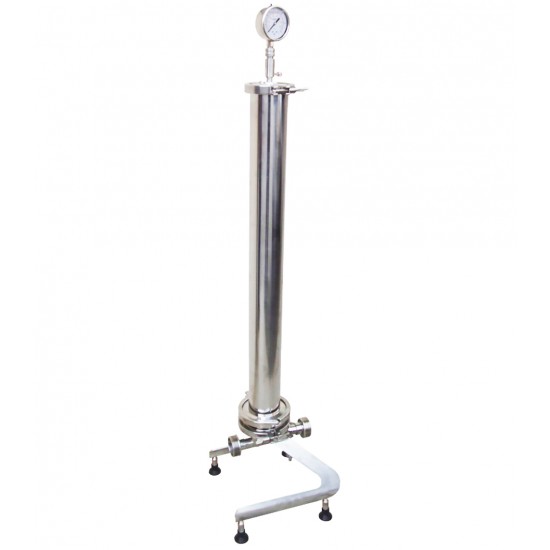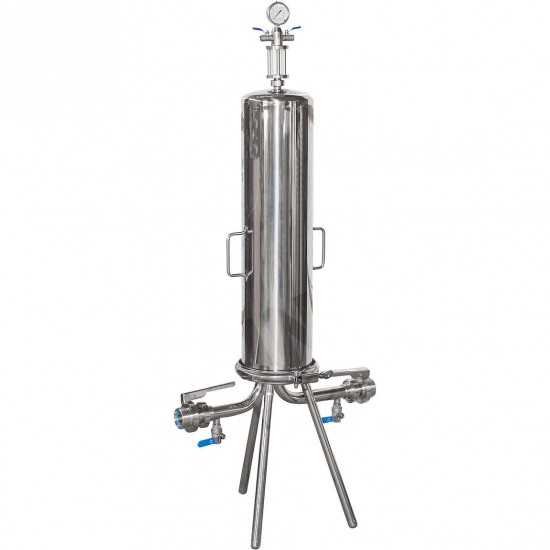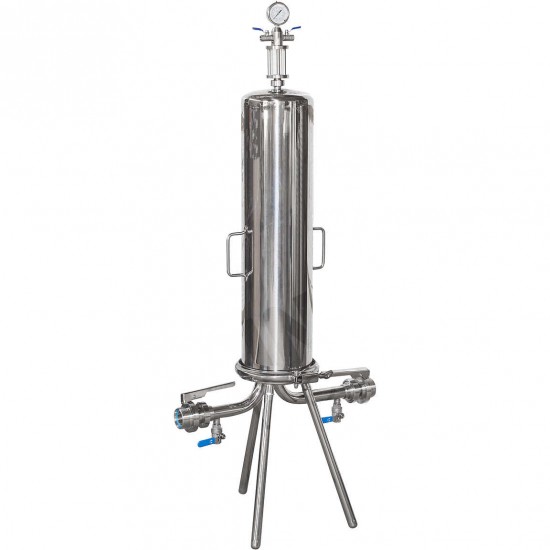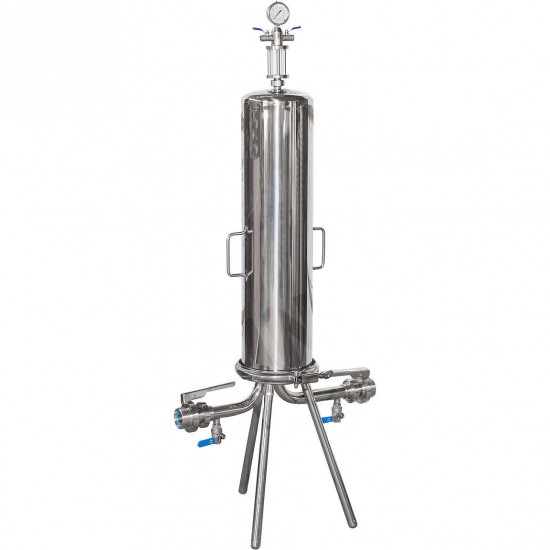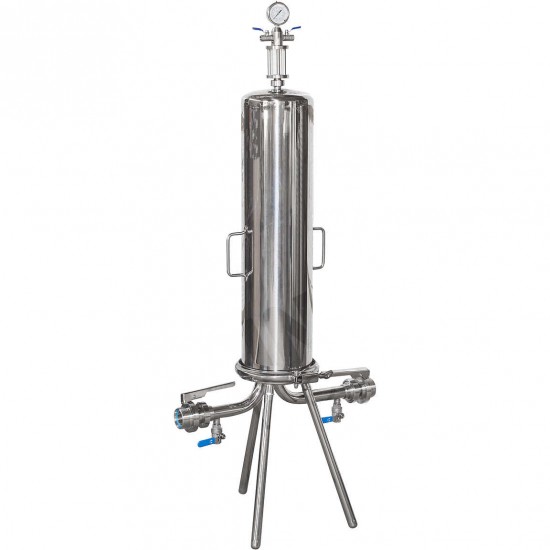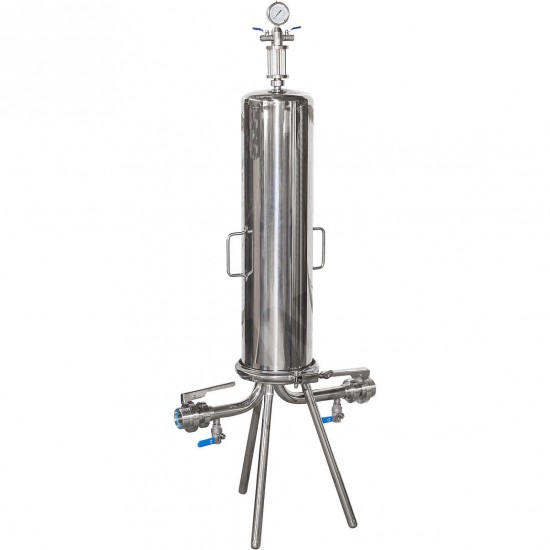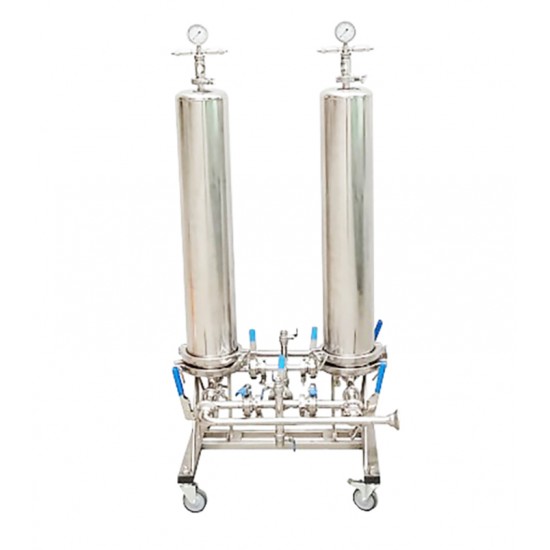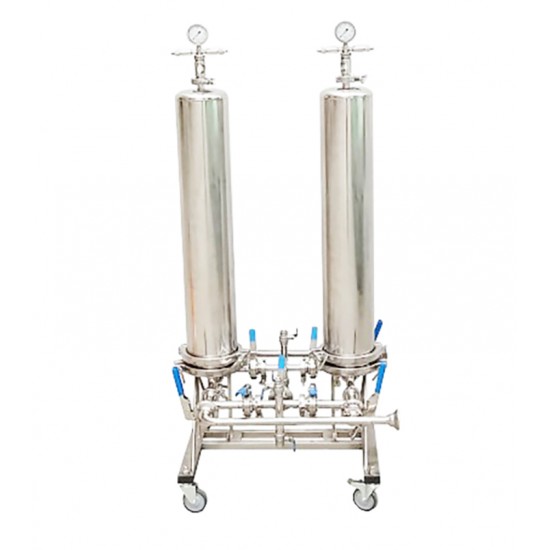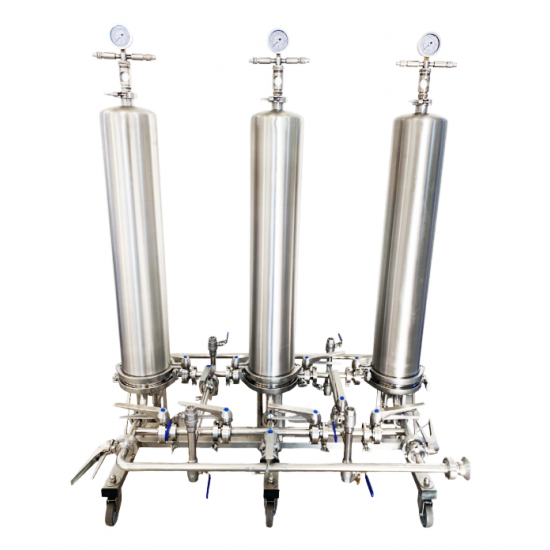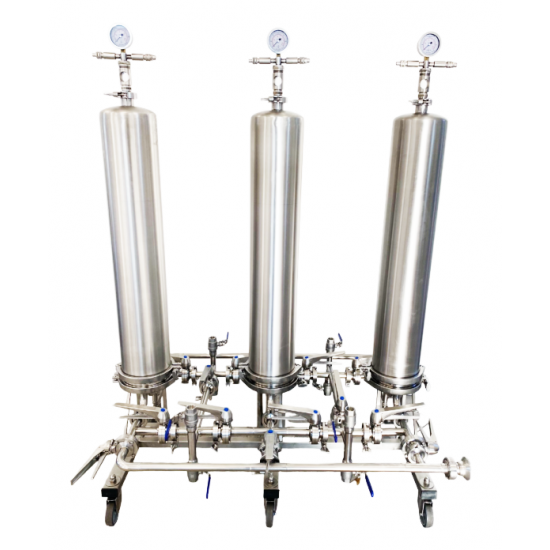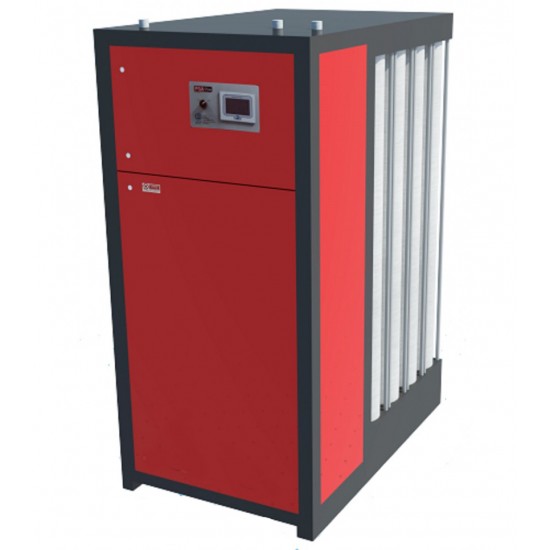

Housing 1-cartridge filter system
AISI 316 Stainless Steel Pressure Filters for Liquids
AISI 316 stainless steel pressure filters are designed for professional filtration of liquids and process fluids in pharmaceutical, chemical, cosmetic, biotechnology, nutraceutical, food and industrial applications. Their AISI 316 stainless steel construction, with polished internal and external surfaces, provides a robust solution for processes requiring good corrosion resistance, cleanability and compatibility with a wide range of products.
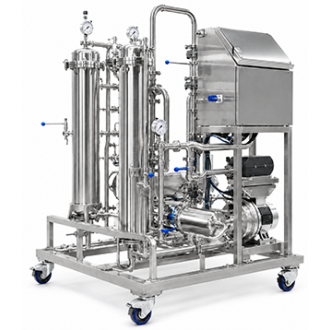
The units are manufactured with a PAL connection and are designed to operate at pressures of up to 10 bar. Standard equipment includes a tubular sight glass for direct visual inspection of the product, a glycerine-filled pressure gauge for monitoring line pressure, and DIN25 inlet and outlet valves. A wide selection of filter cartridges is available to configure the system according to the required filtration level and the characteristics of the liquid being processed.
The filters can be integrated with professional industrial pumping, transfer and dosing systems, creating complete lines for filtration, product handling and controlled liquid processing.
Pressure filtration for laboratories and production plants
Pressure filtration forces a liquid through a filter element by using the pressure differential generated by a pumping system. This configuration is particularly useful when a regular flow must be maintained through cartridges with different filtration ratings or when gravity filtration would not provide the required production rate.
The filter is installed directly in the process line and can be used to remove particles, impurities and suspended residues compatible with the selected filter rating. The cartridge should be chosen according to the liquid, particle size to be retained, viscosity, flow rate and required final result.
For efficient operation, the filter, cartridge, pump and piping should be sized together. A cartridge that is unnecessarily fine may cause a rapid increase in pressure drop and shorten service life, while an excessively open filtration grade may not provide the required product quality.
AISI 316 stainless steel construction
The use of AISI 316 stainless steel makes these pressure filters particularly suitable for processes where corrosion resistance, mechanical strength and high-quality surfaces are important. This material is widely used in professional process equipment for pharmaceutical, chemical, cosmetic and food applications.
The polished internal and external finish supports inspection and cleaning and can reduce product adhesion compared with rougher surfaces. Actual material compatibility must nevertheless always be checked against the product, concentration, temperature and cleaning chemicals used in the process.
For pharmaceutical, cosmetic and food applications, seals, fittings and cartridge materials should also be assessed carefully because the suitability of the complete system depends on all wetted components.
Pressure resistance up to 10 bar
The filter body is designed for operation at pressures of up to 10 bar, allowing integration into professional pumping systems and pressurised process lines within the operating limits of the specific configuration.
The maximum pressure rating should not be considered only as a property of the filter housing. During filtration, the pressure differential across the cartridge must also be monitored, especially as the filter element progressively retains contaminants and becomes more resistant to liquid flow.
Correct system design should therefore consider pump pressure, normal working pressure, line pressure losses and the expected behaviour of the filter cartridge during use.
Glycerine-filled pressure gauge
The glycerine-filled pressure gauge allows immediate monitoring of the pressure inside the filtration system. The glycerine helps dampen pointer vibration and provides a more stable reading when the line experiences pulsation or pressure fluctuations.
Pressure monitoring is particularly useful during filtration because a progressive increase in pressure can indicate cartridge clogging or increasing resistance to flow. This allows the operator to identify when inspection or replacement may be required before system performance falls significantly.
The pressure reading should always be interpreted together with flow rate, viscosity and temperature, since dense liquids may naturally generate higher pressure even when the cartridge is still clean.
Tubular sight glass for visual process control
The integrated tubular sight glass provides a direct visual inspection point in the transfer line. Operators can verify product presence, flow continuity and visible characteristics such as colour, air bubbles, foam or irregular flow behaviour.
This feature is particularly useful during system start-up, product changes, cleaning operations and line draining, when it may be important to distinguish air, cleaning liquid and process product.
The sight glass does not replace a flowmeter, litre counter or analytical instrument, but it provides an immediate and intuitive visual check that can simplify day-to-day process supervision.
DIN25 inlet and outlet valves
The standard configuration includes DIN25 inlet and outlet valves, allowing the filter to be connected to the process line and isolated when required for cleaning, maintenance or cartridge replacement.
The valves make it possible to separate the filter body from the rest of the installation, reducing the amount of piping that may need to be drained during maintenance operations.
Before installation, connection type, line diameter, pressure and seal compatibility should be checked against both the production liquid and the cleaning fluids used in the plant.
Filter cartridges for different filtration requirements
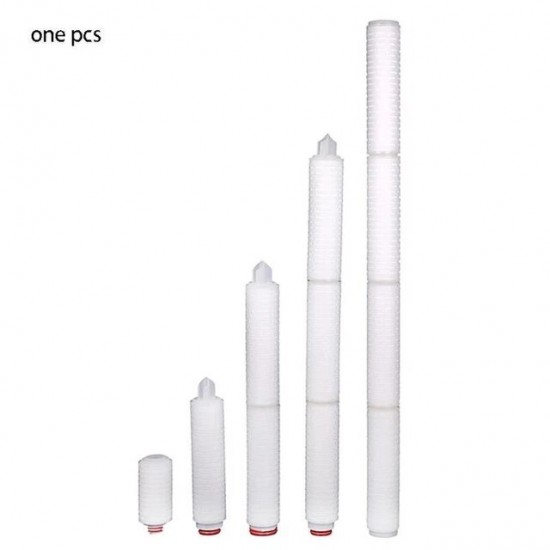
One of the main advantages of cartridge pressure filters is the possibility of using different filter elements for different process requirements. The filtration rating can be selected according to the particle size to be retained, required product quality and characteristics of the liquid.
Different cartridge technologies and materials can be selected according to the application. For correct selection, it is useful to know the liquid type, viscosity, operating temperature, flow rate, contaminant load and required filtration grade.
For liquids containing a relatively high concentration of particles, a staged filtration system may be advisable. A coarser prefilter can remove larger particles before the product reaches the finer final cartridge, potentially increasing cartridge life and reducing operating costs.
Pressure filters for pharmaceutical processing
In pharmaceutical production, pressure filters can be used for compatible solutions, liquid excipients, intermediates, process water and other fluids. Selection should consider not only the filtration grade but also cleanability, wetted materials, seals and the internal procedures applied by the user.
In regulated processes, additional documentation, qualification, cartridge specifications or verification procedures may be required according to the actual application. The filtration system should therefore be integrated into the production line according to the required product and process quality standards.
Liquid filtration systems can be used within production environments that also include equipment for pharmaceutical powder processing, allowing different production stages and dosage forms to be managed within the same facility.
Applications in cosmetic production
In cosmetic manufacturing, pressure filters can be used with compatible solutions, lotions, detergents, extracts, liquid bases, oils and other formulations. The filter can be positioned between preparation and filling or along a transfer line between processing tanks.
The filtration grade should be selected carefully so that unwanted particles are removed without unintentionally retaining ingredients that form part of the desired formulation.
For products containing intentional particles, suspensions or sensitive ingredients, the filtration objective should be clearly defined before selecting the cartridge technology.
Applications in chemical processing
In chemical applications, material compatibility is a critical consideration. AISI 316 stainless steel performs well in many environments, but actual suitability must be checked according to the chemical substance, concentration, temperature and operating conditions.
The cartridge, seals and valves require the same level of attention as the stainless steel housing. A chemically incompatible filter element may deteriorate even when the metal filter body is fully suitable for the liquid.
For reliable selection, it is advisable to provide the product technical data sheet or safety data sheet together with information on the cleaning chemicals used in the system.
Applications in food processing
In food processing, pressure filters can be used for water, beverages, sugar solutions, oils, liquid ingredients and other compatible products. Wetted materials and filter cartridges should be selected according to product-contact requirements and the hygiene procedures used in the plant.
Filtration may be used to remove unwanted particles, protect downstream equipment or prepare the liquid for subsequent processing stages.
Viscosity, operating temperature and solids content have a direct influence on filter sizing, pressure drop and cartridge service life.
Integration with industrial pumps
The filter can be supplied by a professional pumping system. The pump must provide the required flow and pressure without exceeding the permitted operating limits of the filter housing, cartridge, valves and other components.
Integration with industrial pumps for transfer and dosing makes it possible to create complete systems in which the liquid is drawn from the source container, pumped through the filter and then transferred to the next production stage.
Pump selection should consider flow rate, viscosity, filter pressure drop, line length and the pressure required downstream of the filtration stage.
Filtration before dosing and filling
In many applications, the pressure filter can be positioned before dosing and filling equipment to reduce particles that could interfere with valves, nozzles or other precision components.
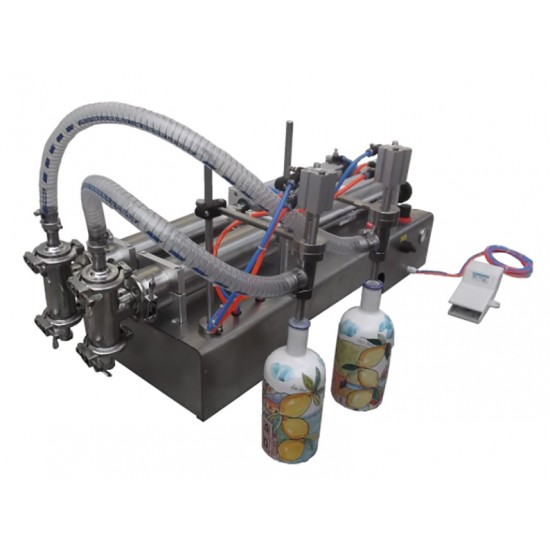
The filtration system can be integrated with professional volumetric filling machines, creating a more complete preparation, filtration and filling line.
The filtration grade should be selected according to both the product and the tolerances of the downstream equipment.
Integration with mixers and agitators
Pressure filtration can be installed after a preparation stage carried out with industrial and laboratory mixers and agitators.
Once mixing has been completed, the product can be transferred through the filter to retain unwanted impurities or particles before storage, dosing, filling or packaging.
The cartridge should always be compatible with the final formulation and should not unintentionally remove ingredients or components that are intended to remain in the product.
Filtration and temperature control
Temperature can have a major influence on filtration performance because it directly affects viscosity. A colder product may become substantially more viscous, increasing pressure drop and reducing the achievable flow rate through the cartridge.
When the process requires controlled temperature, the filtration system can be integrated with industrial liquid chillers and process cooling systems.
Filter sizing should therefore take into account the viscosity of the liquid at the actual filtration temperature rather than relying only on room-temperature data.
Filtration and nitrogen use
Processes involving oxygen-sensitive products may require controlled atmospheres or inert gas during specific production, transfer or storage phases.
Where required, the line can be integrated with industrial nitrogen generators to provide a dedicated source of nitrogen for the process.
The use of inert gas and the design of the complete line should always be defined according to the product and the specific production requirements.
How to choose the correct filter cartridge
Cartridge selection is one of the most important factors affecting filter performance. The required filtration rating, cartridge material, chemical compatibility, temperature, flow rate and contaminant load should all be considered.
A finer cartridge is not automatically better. If the filtration grade is unnecessarily small, pressure drop can increase rapidly, flow rate may decrease and cartridge life can be reduced without providing a useful improvement in product quality.
For products containing significant quantities of suspended solids, progressive filtration or prefiltration can be used to protect the final fine cartridge.
Pressure drop and cartridge saturation
During filtration, the cartridge progressively retains particles and becomes more resistant to liquid flow. This increases the pressure drop and can gradually reduce system throughput.
The pressure gauge provides a useful indication of how operating conditions change over time and can help identify when the cartridge requires inspection or replacement.
Cartridge life depends on the product, contaminant load, filtration rating, flow rate and available filter surface area.
Main advantages of AISI 316 pressure filters
- Professional AISI 316 stainless steel body.
- Polished internal and external surfaces.
- Pressure resistance up to 10 bar.
- PAL connection.
- Tubular sight glass.
- Glycerine-filled pressure gauge.
- DIN25 inlet and outlet valves.
- Wide range of available filter cartridges.
- Different filtration grades and cartridge configurations.
- Integration into pharmaceutical, chemical, cosmetic and food process lines.
How to choose the correct pressure filter
To select the most suitable filter, it is necessary to know the product, viscosity at operating temperature, required filtration grade, desired flow rate, available pressure and approximate quantity of particles or contaminants present.
Cartridge material, seal type, cleaning method, operating frequency and pump configuration should also be considered.
A complete technical assessment helps avoid over- or undersizing the filter and makes it possible to select a cartridge genuinely suited to the process.
Cleaning and maintenance
The filter should be cleaned according to the product characteristics and the operating procedures defined by the user. After depressurising and isolating the line, the cartridge can be removed for replacement or for the maintenance procedure applicable to the selected filter element.
The filter body, sight glass, seals, valves and pressure gauge should be inspected periodically. Leaks, damage and product deposits should be identified and corrected before returning the equipment to service.
Before repressurising the system after maintenance, all components should be correctly assembled and the complete unit should be checked for safe operation under the intended pressure conditions.
Why choose Ariacqua?
Ariacqua supplies AISI 316 stainless steel pressure filters and a wide range of cartridges for pharmaceutical, chemical, cosmetic, biotechnology, food and industrial applications. Each configuration is evaluated according to the raw material, flow rate, viscosity, required filtration grade and actual operating conditions.
The possibility of integrating filtration, pumping, mixing, temperature control, dosing and other process technologies makes it possible to develop complete solutions tailored to the needs of laboratories and production plants.
Frequently asked questions about AISI 316 pressure filters
Why use an AISI 316 stainless steel pressure filter?
An AISI 316 pressure filter is suitable when a robust, corrosion-resistant and professional filtration housing is required for liquid processing. AISI 316 stainless steel offers good resistance in many pharmaceutical, chemical, cosmetic, food and industrial applications, while polished internal and external surfaces facilitate inspection and cleaning. The material should not, however, be selected only according to the industry. Actual compatibility depends on product composition, concentration, temperature and the substances used during cleaning. Seals, cartridges and every other wetted component must also be evaluated. An AISI 316 filter therefore provides a versatile foundation for a professional filtration system, but the complete configuration must always be matched to the actual process conditions.
What does a pressure rating of up to 10 bar mean?
A pressure rating of up to 10 bar indicates the maximum operating pressure specified for the filter configuration and is an important parameter when integrating the unit with pumps and process piping. It does not mean that the system should continuously operate at maximum pressure. Normal operating pressure depends on pump output, product viscosity, pipe diameter and, especially, the resistance created by the cartridge. As the filter element captures more contaminants, pressure drop may increase. The pressure gauge helps operators monitor this change. All components, including the cartridge, valves, fittings and filter housing, must always remain within their permitted limits. The maximum pump pressure should therefore be considered during the design of the complete filtration line.
How should the cartridge filtration grade be selected?
The filtration grade should be selected according to the particle size that must be retained and the required final product quality. Choosing the finest cartridge available is not automatically the best solution. An unnecessarily fine rating may increase pressure drop rapidly, reduce flow rate and shorten cartridge life without providing a meaningful process benefit. Selection should consider the liquid, amount and type of contamination, viscosity, flow rate and the requirements of downstream equipment. In some applications, staged filtration may be preferable: a coarse prefilter removes larger particles and protects the finer final cartridge. This can improve process continuity and optimise cartridge consumption. Cartridge material and compatibility with both the product and cleaning chemicals should also be considered.
What is the purpose of the tubular sight glass?
The tubular sight glass creates a direct observation point in the process line and allows the operator to see the product as it passes through the system. It can be used to confirm product presence, verify that transfer has started, observe air bubbles, foam or visible irregularities and monitor cleaning or draining operations. It is particularly useful during start-up, when the line may initially contain air, and during product changes. The sight glass does not automatically measure flow rate or volume and does not replace electronic sensors or analytical instruments. Its main advantage is the immediate visual information it provides. To maintain this function, the transparent section must be kept clean and must be compatible with the product, pressure, temperature and cleaning chemicals.
Why is a glycerine-filled pressure gauge useful?
The pressure gauge provides immediate information about line pressure and is especially useful for monitoring how the filter behaves over time. A glycerine-filled gauge gives a steadier reading in systems affected by vibration or pressure pulsation because the liquid dampens pointer movement. During filtration, an increase in pressure compared with normal operating conditions may indicate increasing resistance, often caused by progressive cartridge saturation. Pressure should always be interpreted together with flow rate, temperature and viscosity because a dense product can generate a higher pressure even when the cartridge is clean. Regular monitoring therefore helps operators recognise changes in system behaviour and schedule cartridge inspection or replacement before productivity falls excessively.
Can the pressure filter be used with viscous products?
Yes, but viscosity must be considered carefully when sizing the system. A viscous product passes through a cartridge less easily than a low-viscosity liquid and therefore generates a higher pressure drop. This may require a larger filtration area, a suitable filtration grade and a pump capable of providing the required pressure without exceeding the operating limits of the system. Temperature is often important because many liquids become less viscous when heated. It is therefore essential to know the viscosity at the actual filtration temperature rather than only at room temperature. In some applications, flow rate may need to be reduced or progressive filtration may be advisable. Cleaning should also be considered because viscous products can leave more residue inside the housing and on the cartridge surface.
How is the filter integrated with a pump?
The pump should be selected together with the filter by considering flow rate, pressure, viscosity, pipe diameter and expected cartridge pressure drop. The liquid is drawn from the source vessel and pushed through the filter housing. When the cartridge is clean, resistance may be relatively low; as particles accumulate, pressure drop progressively increases. The pump must therefore have sufficient capacity to maintain the required flow without exceeding the pressure limits of the filter or other system components. Excessive oversizing should also be avoided, as it can create unnecessary pressure conditions that are more difficult to control. The pressure gauge and inlet/outlet valves support system management, while well-designed piping helps minimise additional losses.
What information is required to select the correct filter and cartridge?
Reliable selection requires information about the product, chemical composition, viscosity at working temperature, minimum and maximum temperature, desired flow rate, available pressure and approximate amount of particles present. The required filtration grade should also be defined and, when possible, the approximate size of the particles to be removed. Cleaning chemicals should be specified because the filter housing, seals and cartridge must be compatible with the complete operating cycle. Information about pump type, pipe configuration and downstream equipment is also useful. Pharmaceutical, cosmetic and food applications may require additional consideration of product-contact materials and internal process procedures. With these data, the filter can be sized more accurately and a cartridge can be selected that is genuinely compatible with the intended application.
Customized Professional Equipment & Tailor-Made Solutions
We supply high-quality professional equipment and customized solutions designed to meet the specific needs of every customer. Our experienced team provides expert support in selecting the most suitable products, offering reliable solutions, technical assistance and tailor-made configurations for companies, laboratories, industrial applications and professional environments.
Contact us for product information, personalized advice and professional support in choosing the ideal equipment for your business requirements.
Enabled filters:
Filter system Housing 1 bell of 3 cartridges
Filter system Housing 1 bell of 5 cartridges
Housing 1 filter system with 8 cartridges
Housing 1 filter system with 12 cartridges
Filter system Housing 1 bell 18 cartridges
Filter system Housing 2 1-cartridge
Filter system Housing 2 bells of 3 cartridges
Filter system Housing 3 bells 1 cartridge
Filter system Housing 3 bells with 3 cartridges